
Medical Travel Insurance: The Complete Guide Every Traveller Needs in 2026
Whether you’re flying from London to New York or booking a holiday in Southeast Asia, one thing you should never leave home without is solid medical travel insurance. It’s not just a checkbox, it’s a financial safety net that can save you from bills running into tens of thousands of pounds or dollars if something goes wrong abroad.
At FRFV (Flight Reservations for Visa), we help travellers manage every layer of their journey from flight reservations for visa applications to hotel booking for flight reservations and now, helping you understand the insurance coverage that protects your health while you travel.
What Is Medical Travel Insurance and Why Does It Matter?
Medical travel insurance is a specialised type of policy that covers emergency healthcare costs when you’re travelling outside your home country. Your domestic health plan, whether that’s the NHS in the UK or a private plan in the US, typically offers little to no protection the moment you cross an international border.
A single night in a US hospital can cost upwards of $10,000. Emergency medical evacuation back to the UK can exceed £150,000. Without a proper travel medical insurance policy in place, you’re personally liable for every penny.
The good news? A solid policy often costs as little as £5–£10 per day, a tiny price compared to what you’re protecting yourself against.
What Does Travel Medical Insurance Typically Cover?
A comprehensive medical insurance for travel policy generally includes:
- Emergency hospitalisation : inpatient and outpatient treatment for sudden illness or injury
- Emergency medical evacuation : transport to the nearest appropriate medical facility or repatriation home
- Ambulance costs : ground and air ambulance fees
- Prescription medication : emergency drugs prescribed during your trip
- Repatriation of remains : in the unfortunate event of death abroad
- 24/7 emergency assistance : access to a helpline any time of day or night
Some comprehensive policies also include trip cancellation, baggage cover, and personal liability — though these are secondary to the core medical benefits.
Travel Insurance for Medical Conditions: What You Must Know Before You Buy
This is where many travellers make costly mistakes. If you have a pre-existing health issue, you cannot simply buy a standard policy and assume you’re covered. Travel insurance for medical conditions works differently, and the rules are strict on both sides of the Atlantic.
What Counts as a Pre-Existing Condition?
In insurance terms, a pre-existing condition is any illness, injury, or health issue for which you’ve received treatment, diagnosis, or prescribed medication — typically within the past 12 to 24 months. Common conditions that must be declared include:
- Diabetes (Type 1 and Type 2)
- Asthma and other respiratory conditions
- Heart disease, high blood pressure, or atrial fibrillation
- Cancer (active or in remission)
- Anxiety, depression, or other mental health conditions
- Stroke or TIA history
- Crohn’s disease and other chronic illnesses
The Golden Rule: Always Declare
Travel insurance with medical conditions only works if you’re honest with your insurer. Failing to declare a condition — even a well-managed one — can invalidate your entire policy. That means a claim for an unrelated injury could still be rejected if your insurer discovers an undisclosed health history.
UK-based regulatory bodies and US insurance guidelines both require full disclosure. Declaring a condition doesn’t automatically price you out of the market; in many cases, standard insurers cover minor conditions at little or no extra cost.
How to Find the Right Travel Insurance With Medical Conditions
Not all insurers are created equal. Here’s a practical approach to finding travel insurance for medical conditions that genuinely protects you:
Step 1 — Go through medical screening. Most specialist insurers ask condition-specific questions to assess your risk and offer appropriate cover. This process is your friend — it ensures your policy is built around your actual health situation.
Step 2 — Compare limits, not just premiums. A cheap policy with a £20,000 medical cap is close to useless if you’re travelling to the US. Look for policies offering a minimum of $100,000 to $500,000 in emergency medical cover for American destinations.
Step 3 — Check the stability clause. Many policies require your condition to have been stable (no new treatment, hospitalisation, or medication changes) for 60 to 180 days before the travel date. If you’ve had a recent flare-up or change in treatment, specialist insurers may still cover you — but you’ll need to shop carefully.
Step 4 — Buy cover as soon as you book. This is especially important for travel insurance with medical conditions. Booking early means you’re protected for cancellation if your health deteriorates before departure.
Medical Travel Insurance for Visa Applications
Many countries now require proof of medical insurance for travel as part of their visa application process. Schengen visa applications across Europe, for example, mandate a minimum of €30,000 in emergency medical coverage. Several countries in Asia, the Middle East, and North America have similar requirements for tourist and business visas.
At FRFV, our flight reservation services for visa applications are regularly paired with guidance on meeting these insurance requirements. Whether you need a flight reservation for visa purposes or assistance confirming your hotel booking for flight reservations, having your insurance documentation aligned with visa requirements is essential.
Medical Insurance Travel: USA vs. UK Travellers - Key Differences
For UK travellers visiting the USA: The NHS provides no coverage in the United States. American healthcare is among the most expensive in the world. UK visitors should carry a minimum of $500,000 in emergency medical cover and check whether their policy covers acute onset of pre-existing conditions — a specific provision that covers sudden flare-ups even if your underlying condition was declared.
For US travellers visiting the UK: The UK’s NHS does not extend free treatment to non-residents in most cases. While costs are generally lower than the US, emergency treatment, repatriation, or evacuation can still be financially devastating without cover.
For travellers from other regions: Wherever you’re based — Australia, Canada, the UAE, India, or Pakistan — medical insurance travel is non-negotiable for long-haul or high-cost destination trips. Policy availability and pricing vary significantly by nationality and destination, so comparison is key.
How FRFV Supports Your Complete Travel Preparation
At FRFV (Flight Reservations for Visa), we understand that travel preparation goes beyond booking a seat on a plane. Our services include:
- Flight reservations for visa — dummy ticket reservations accepted by embassies worldwide
- Hotel booking for flight reservations — verified accommodation confirmations for visa applications
- Travel document guidance and trip planning support
We encourage every traveller using our platform to secure appropriate medical travel insurance before departure. It’s the one document that embassies ask for — and the one that truly matters when things go wrong.
How to Apply for Medical Travel Insurance Through FRFV — Step-by-Step
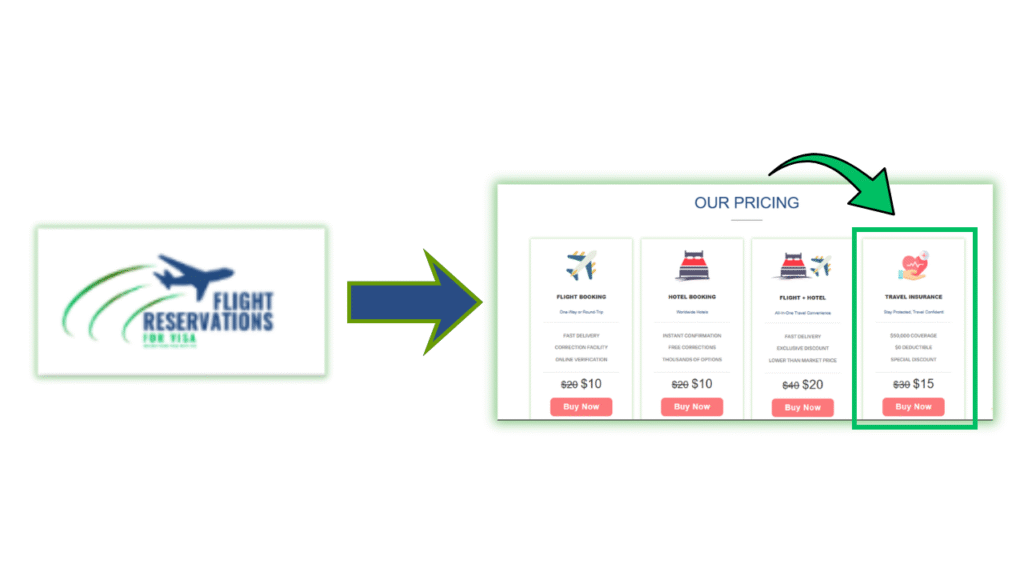
Getting medical travel insurance through FRFV is straightforward and takes less than five minutes. The online application form at flightreservationsforvisa.com/medical-travel-insurance is divided into clear sections. Here’s exactly what to expect at each stage.
Step 1 — Enter Your Personal Details
The first section asks for basic identification information. You’ll need to provide:
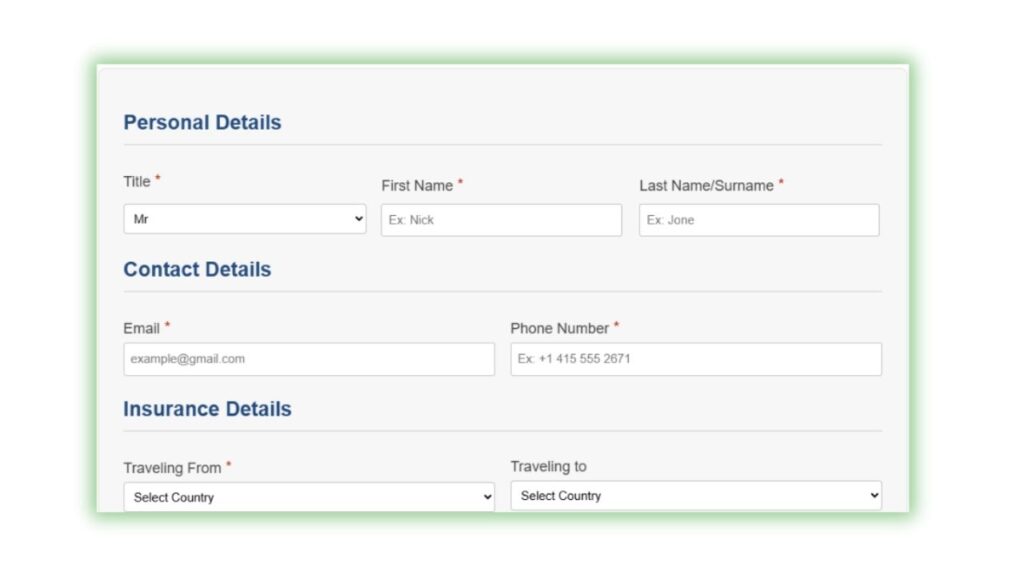
- Title — select Mr, Ms, Mrs, or Other
- First Name and Last Name/Surname — enter your name exactly as it appears on your passport

This information is used to generate your insurance document, so accuracy here matters. Any discrepancy between your insurance certificate and your passport could cause issues at a visa appointment or border check.
Step 2 — Provide Your Contact Details
Next, enter your email address and phone number. Your insurance documents will be delivered to the email you provide, so double-check it before moving on. FRFV typically delivers completed insurance documents within 12 to 24 hours, including weekends. If you need your documents faster, an urgent delivery option is available later in the form.
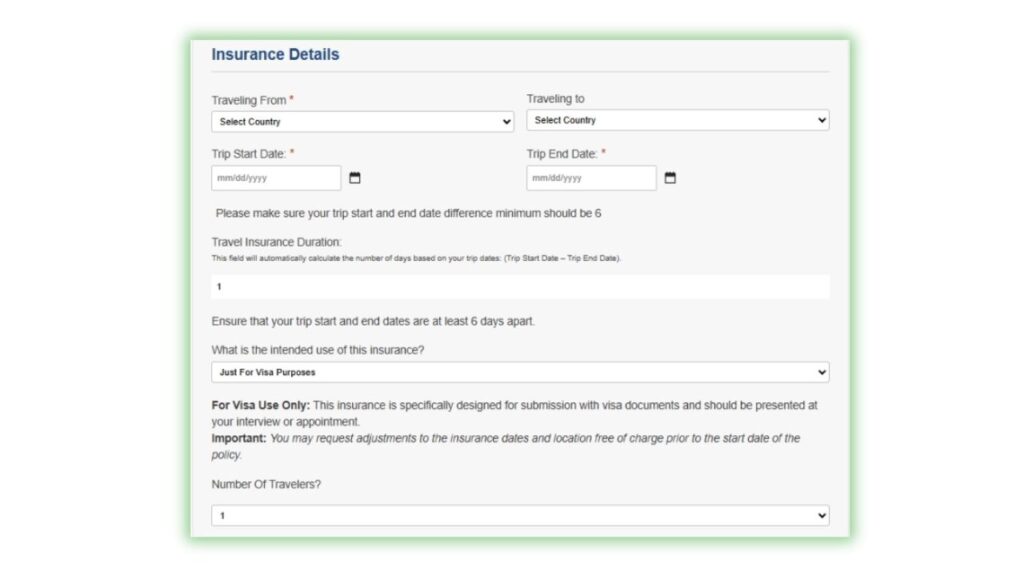
Step 3 — Fill In Your Insurance Details
This is the core section of the travel medical insurance application. You’ll need to know the following before you start:
- Traveling From — select your departure country from the dropdown
- Traveling To — select your destination country
- Trip Start Date — the date you leave home (use MM/DD/YYYY format)
- Trip End Date — the date you return home
The form automatically calculates your Travel Insurance Duration based on the dates you enter. Note that your trip start and end dates must be at least 6 days apart — the form will flag an error if the gap is shorter.
You’ll also be asked about the intended use of the insurance. Two options are available:
- Just For Visa Purposes — this option is specifically for travellers who need the insurance document to submit with a visa application. If your travel plans change before the policy start date, FRFV will adjust the dates and destination free of charge.
- Visa + Actual Journey Useable — this option provides coverage that is valid both for your visa submission and for actual use during your trip.
Finally, select the Number of Travellers being covered (from 1 to 8 people).
Step 4 — Complete Each Traveller’s Information
For each traveller included in the policy, you’ll fill in a dedicated section with the following details:
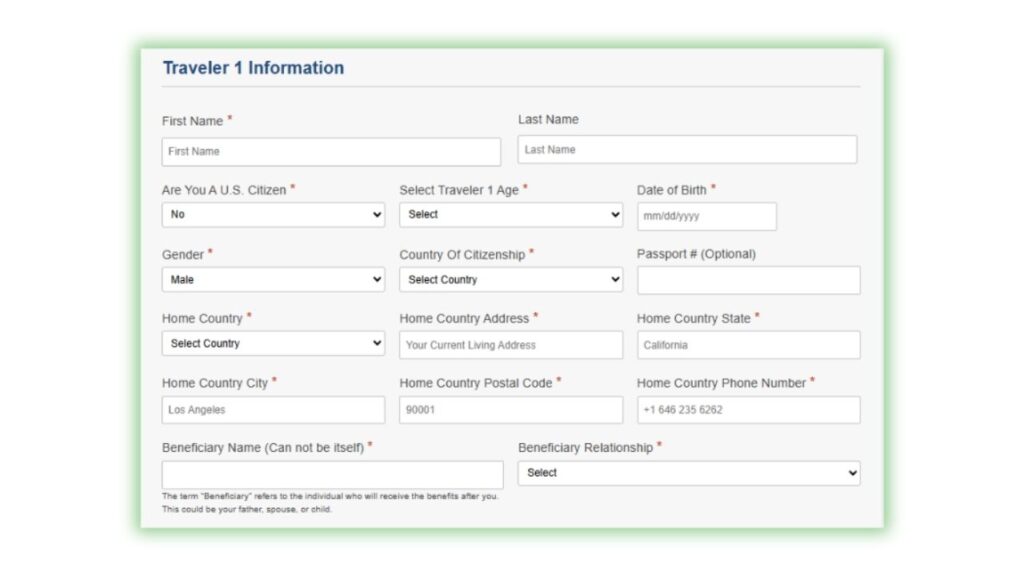
- First Name and Last Name
- US Citizenship status — select Yes or No
- Age bracket — choose the appropriate range (e.g., 22–29, 30–39, up to 100–109)
- Date of Birth
- Gender — Male or Female
- Country of Citizenship
- Passport Number — optional but recommended for accuracy
- Home Country — select from the dropdown
- Home Country Address, State, City, and Postal Code — your full residential address
- Home Country Phone Number
- Beneficiary Name — the person who would receive benefits in the event of a claim. This cannot be the traveller themselves; it must be a spouse, parent, child, or other named relative.
- Beneficiary Relationship — select Spouse or Other

If you’re applying for multiple travellers, you’ll repeat this section for each person. Up to 8 travellers can be covered under a single application.
Step 5 — Choose Your Delivery Speed
Once all traveller details are complete, you’ll see a Delivery Option section. Standard processing delivers your documents within 12 to 24 hours at no extra cost. If you need faster turnaround, two urgent service upgrades are available:
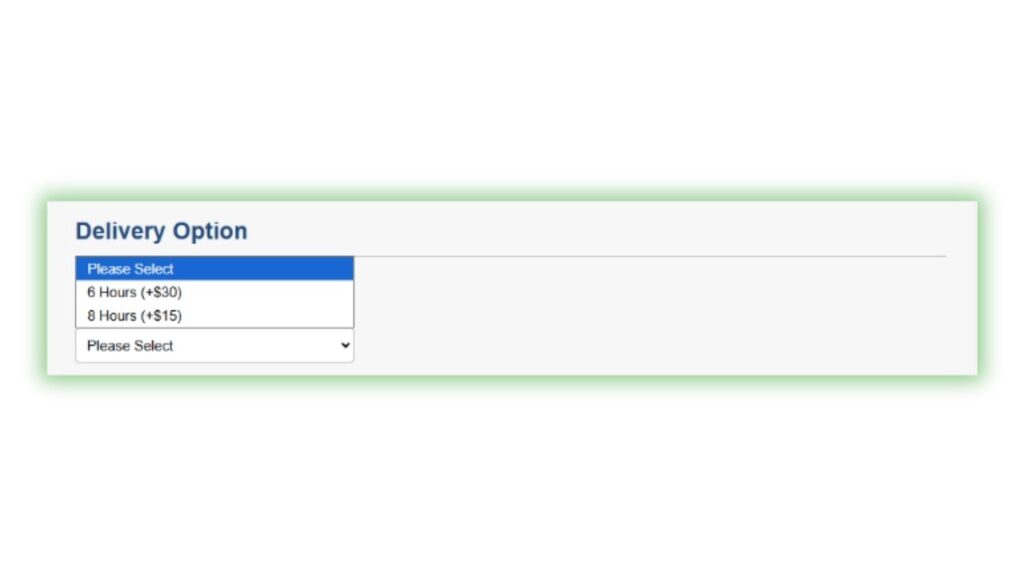
- 6-Hour Urgent Delivery — an additional $30
- 8-Hour Urgent Delivery — an additional $15

Choose urgent service if your visa appointment is imminent or you’re travelling soon.
Step 6 — Review the Order Summary and Pay
Before submitting, review your Order Summary, which displays the total cost of your travel medical insurance for visa or journey use, plus any urgent service fee. FRFV accepts payment by credit and debit card, including all major card networks. The payment process is secure and handled directly on the platform.
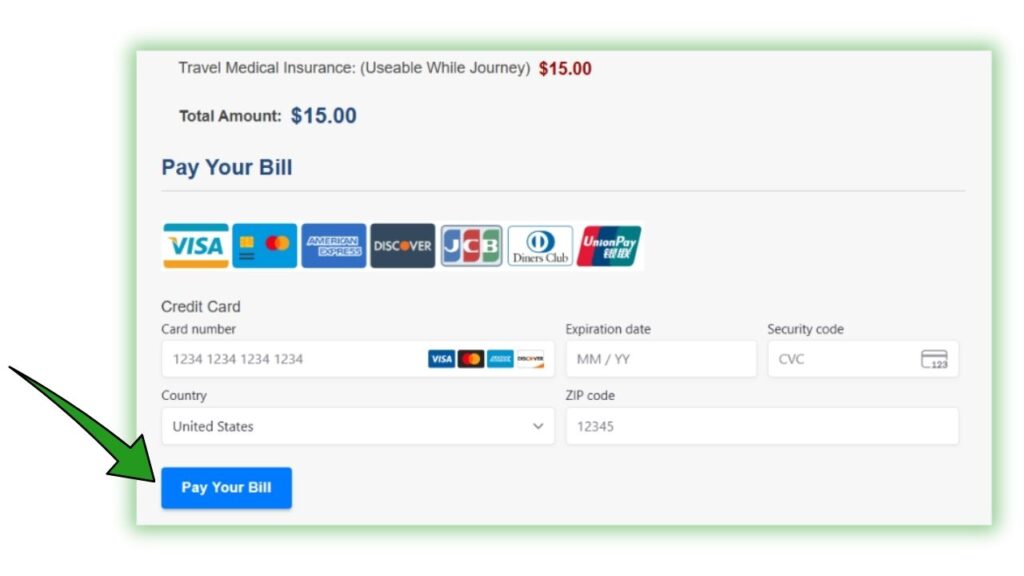
Once payment is confirmed, your application is submitted. You’ll receive your insurance documents by email within the selected timeframe — ready to attach to your visa application or carry on your trip.
Tips for Filling the FRFV Medical Insurance Form Correctly
A few things worth knowing before you start:
Make sure the trip start date is not in the past policies can only be issued for future travel dates. If you’ve chosen “Visa Purposes Only,” you can request a date adjustment free of charge before the policy start date. Always use your legal name as shown on your passport not a nickname or shortened version. And if you’re applying for a group, keep all travelers’ passport details to hand before opening the form, as you’ll need each person’s date of birth, citizenship, and home address.
FRFV is your trusted partner for travel documentation and preparation. Explore our flight reservation and hotel booking services to complete your visa application requirements with confidence.
FAQs
Yes. Specialist insurers cover serious conditions including active cancer, heart disease, and post-stroke travel. Premiums will be higher, but coverage is available.
Yes. A minimum of €30,000 in emergency medical cover is a legal requirement for Schengen visa applicants.
Most current policies do include COVID-19 treatment as a standard medical event. Check your policy wording to confirm.
As early as possible ideally the same day you make your first trip payment. This ensures you’re covered for pre-departure cancellations.